Showing posts with label Mary Lydon Simonsen. Show all posts

Friday, 15 February 2019

Persuasion - Behind the Scenes by Various Authors - Blog Tour

Persuasion - Behind the Scenes by the Austen Authors
Today I am bringing you a post that I'm really excited about for a few reasons. One, the Austen Variations authors have brought out a joint work (woohoo!). Two, it's based on Persuasion! Much as I love P&P, I also love Austen's other works, so I am so pleased to see a new book based on another of her novels. Thirdly, I am welcoming Kara Louise back to the blog, which is always lovely.

Let's have a look at the blurb of Persuasion - Behind the Scenes, and then hand over to Kara Louise for a guest post, including an excerpt. If you read right until the end, you will find that there's a giveaway too!

Book Description

You pierce my soul.

Before Jane Austen wrote that romantic letter from Captain Frederick Wentworth to Anne Elliot, she crafted a masterful story of heartbreak and longing that still resonates with readers today.

But what of those scenes that Jane Austen never wrote?  What Persuasion fan doesn't want to listen in on Anne and Wentworth's first courtship, laugh at the follies and foibles of the Elliot family, sail along on Captain Wentworth's harrowing adventures at sea or attend Wentworth and Anne's wedding.

Twelve authors of Austen-inspired fiction:  Diana Birchall, Marilyn Brant, Jack Caldwell, L.L. Diamond, Maria Grace, Cassandra Grafton, Kara Louise, Susan Mason-Milks, Jane Odiwe, C. Allyn Pierson, Mary Lydon Simonsen, and Shannon Winslow collaborated to put this unique collection that fills in "missing" scenes from Austen's classic work, sure to delight any true Persuasion fan.

Guest Post from Kara Louise

I want to thank Ceri for allowing me to visit her blog today to talk share with you about a newly released book, Persuasion ~ Behind the Scenes. This is an anthology of missing scenes from Jane Austen’s novel written by 12 different authors. 

As I pondered what to write about for this post, I began looking closely at Persuasion and realized how conducive it is for writing missing scenes. Why is that? Well, there is a lot of backstory. In fact, the whole initial romance between Anne Elliot and Frederick Wentworth takes place before the novel begins. How did they meet? What was their love like? What were they like? What was his proposal like? What about when he applied to Sir Walter Elliot for her hand? How was it that Lady Russell was able to persuade Anne to give him up?

There are other backstories, as well. Their cousin, William Elliot, has a backstory that affected his relationship with Anne’s family. What happened? Wentworth’s time at sea has a backstory. There was Charles Musgrove’s proposal to Anne, and Mrs. Smith has a backstory.

In addition to backstories, there are many scenes that are only briefly alluded to, or barely mentioned at all. How did Wentworth hear about his sister and the admiral letting Kellynch? What were his feelings when he went to visit his sister and her husband at Anne’s home? Can we have more details on Anne and Wentworth’s first encounter? How did the engagement come about between Benwick and Louisa? And finally, what about the wedding - and after - for Wentworth and Anne?

As you can see, Persuasion is the perfect novel to be expanded upon.

Now, here is a little teaser of a post I wrote on Wentworth’s reflections as he rode to visit his sister and the admiral at Kellynch. 

~*~

Book cover: Persuasion Behind the Scenes by the Austen Variations Authors
“Whoa!” Captain Frederick Wentworth gave a slight tug on the reins, bringing his horse to a stop. He took in a deep breath and his heart began to pound as looked at the crossroads before him.

Taking the road to the left would lead to Taunton, where his brother had served as cleric. How often he took this road when he was visiting Edward. His mouth grew dry as he slowly turned to the right. The road to the right led to Kellynch Hall.

He gave the horse a slight kick and pulled the reins to the right. He did not wish to gallop to Kellynch; he would take it slowly, for the feelings that had resurfaced since discovering his sister and her husband were letting Anne’s home, or at least her former home, had assaulted him with great force.

Has it really been eight years? Wentworth felt as though it was just yesterday that he travelled this road. He knew it well, almost by heart.

As the horse moved slowly along, Wentworth took in the landmarks that were familiar, yet not. There was the gnarly old tree with the large hole in it. He and Anne often commented about the birds or animals that might seek refuge in it. He believed the wise owl would have claimed it as its domain, while Anne thought it would be a perfect respite for a peaceful pair of nesting doves.

The road crossed a dried stream bed, and he recollected how it had flowed with water when he had been here last, after several days of rain. Up ahead and around the curve would be the large tree under which he and Anne sat, shaded by the canopy of leaves.

At the turn in the road he came to abrupt halt. The tree had broken off along the trunk and fallen. Its tangled, lifeless branches were strewn across the meadow, void of any greenery. A few small twigs were sprouting from the trunk where it had split, attempting, so it seemed, to bring life back into it. He surmised it was a useless case.

Will I see her? He shook his head, wondering which he feared more: encountering her again or not seeing her. The family was apparently going to reside in Bath, so most likely he would be spared having to face her. A very familiar sense of regret flooded him, causing an ache that was as fresh as when she first broke off their engagement. In recent years those feelings had gradually diminished as he resolutely pushed them down when they chanced to surface. Until, that is, he received the letter from his sister, informing him about their letting of Kellynch.

Another bend in the road and a slight incline were all that was left before he would have his first view of the manor since leaving these parts in great anguish of soul.  He nudged the horse along, knowing exactly what he would see. The place was etched in his mind, and it held such tender memories as well as heartrending ones.

He shook his head and kicked the horse soundly. Enough of this sentimentality! Miss Anne Elliot has no hold over my heart any longer!

The horse took off in a fierce gallop, as if sensing its rider’s mood, leaving a trail of kicked up dust behind them.

  * * *

Author Bio

Author Kara Louise
Kara Louise began writing Austen inspired stories in 2001 and began publishing them in 2006. She has written sequels, variations, different POV retellings, and modern versions of “Pride and Prejudice.”

She grew up in the San Fernando Valley, just north of Los Angeles. She and her family moved to Kansas from Los Angeles in 1991, and in September, 2013, she and her husband moved to 5 wooded acres in the St. Louis area to be near their son and his wife. They now have two granddaughters they enjoy spending time with. They also love animals, and have an ever changing number of cats and dogs.

Buy Links

You may have made the decision that you must buy this book immediately. If you have made this decision I will try and help you as best I can. Here are some buy links:


Giveaway Time!

There is a wonderful giveaway accompanying the blog tour. Take a nosey at these prizes!

Lovely prizes

To enter, please use the rafflecopter.


Blog Tour Schedule

Check out the other stops on the blog tour!

Persuasion - Behind the Scenes - Blog Tour Schedule


Friday, 6 June 2014

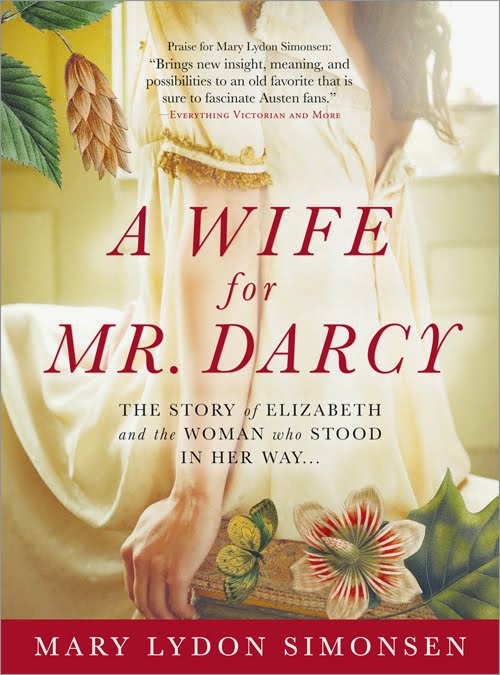
A Wife for Mr Darcy by Mary Lydon Simonsen

When I read The Perfect Bride for Mr Darcy recently I referred to this book so I thought I'd share my review of it with you. I read this at the end of last year...

Book cover: A Wife for Mr Darcy by Mary Lydon Simonsen
This is a Pride and Prejudice variation. What if Mr Darcy realised that Elizabeth may have overheard his slighting comment about her at the Meryton Assembly and went to apologise to her? They start off on much better terms, so much so that when Mr Wickham comes to Hertfordshire spreading his tale of woe Lizzy doesn't believe it.

In Pride and Prejudice, once Elizabeth overcomes her dislike of Mr Darcy she falls in love with him pretty quickly and this is what happens here, but there is a fly in the ointment in the fact that prior to coming to Netherfield Mr Darcy had begun a courtship in London of a Miss Letitia Montford and now feels himself bound in honour to her.

Recognising that Darcy's honour is going to lead him to a life of misery Miss Darcy, Colonel Fitzwilliam and his elder brother Lord Antony Fitzwilliam spring into action to try their hand at unravelling the problem through a series of entertaining plots.

Both Fitzwilliam brothers are wonderful characters, lots of fun. However, Lord Antony Fitzwilliam really steals the show. He refers to his estranged wife as the Evil Eleanor, dresses ten years out of fashion so he stands out, is a colossal flirt with married ladies and has some wonderful droll dialogue.

"This does not sound like the Darcy I know," Antony said. "But if he is not going to learn from my mistakes, then why should I help him? On the other hand, he is my cousin, and on occasion has lent me money. 

There is also a fantastic scene where Georgiana visits Mrs Redford, who is Miss Montford's companion, and we see that the scheming isn't all one-sided.

Since much of the book focuses on Darcy's family there is not so much of the Bennets, although we see Jane Bennet show unexpected steel in taming Bingley's niece and nephews (children of another sister who is not mentioned in P&P).

I would have liked to have seen a bit more Lizzy, and a bit more wooing on Mr Darcy's part. Due to his impending courtship he is unable to make overtures towards Elizabeth for some time. She thinks at one point "Why is it that a man of sense and education, who had lived in the world, found it so difficult to speak in declarative sentences that didn't require an interpreter?" and I had a lot of sympathy for her view, although I understood his reasoning. By the time he is free to win his lady she is already won and he doesn't really need to put much effort in, I thought she deserved a bit more.

There is some behaviour that I don't think was in line with norms of the day, such as unmarried ladies sitting on the same side of the carriage as men and receiving letters from men who weren't relations, and there was also some language use that didn't seem quite right for a book set in England in this period such as a house having a foyer instead of a hall etc. However, I thought this was a very entertaining and lighthearted read. It's very humorous. I'd certainly recommend this book and I hope that Antony features in other books, I'd love to see more of him!


Saturday, 31 May 2014

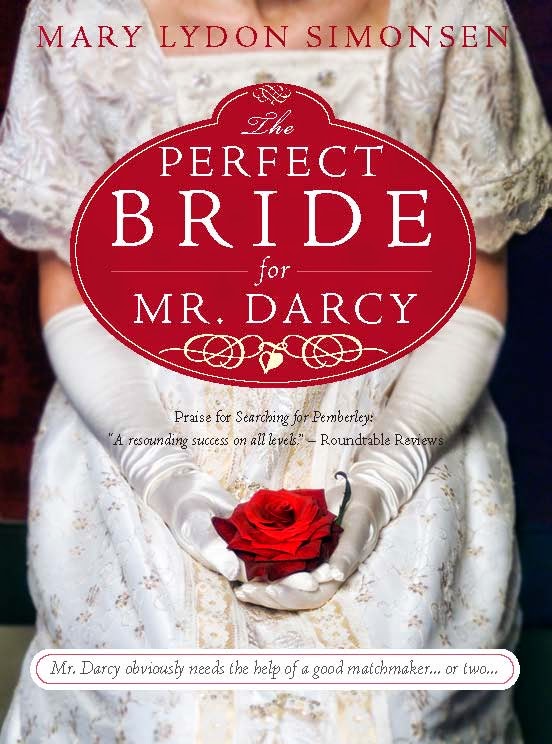
The Perfect Bride for Mr Darcy by Mary Lydon Simonsen

The Perfect Bride for Mr Darcy by Mary Lydon Simonsen book cover
This Pride and Prejudice variation starts at the beginning of P&P, with a few chapters summarising the events, but more from Darcy’s point of view than Elizabeth’s. Darcy still offends her and still interferes with Bingley and Jane.  He goes to visit Lady Catherine at Rosings, not on a duty visit as in canon, but because Mrs Hurst mentioned that Elizabeth would be visiting her cousin in Kent.  Darcy has no intention of proposing when he goes to Hunsford Parsonage, which is why his proposal is so bad. Darcy is very close to his cousin Anne and he confides in her what has happened.

Anne decides on a plan of action to help her cousin successfully woo Miss Bennet, and she begins by befriending her. Elizabeth is much less strongly against Darcy than in canon and although she sees that Anne is trying to repair her opinion of Darcy Elizabeth is regretful of her treatment of him and she’s happy to enter into a correspondence with Anne. This means that Anne is aware of Elizabeth’s plans and whereabouts and she’s more able to arrange a ‘chance’ meeting between Elizabeth and Darcy.

The thing I probably liked best about this book was the fleshing out of Anne’s character. Although frail, she is a very determined lady (well, she is Lady Catherine’s daughter after all!) She genuinely loves her cousins and wants the best for them. Georgiana is also very sweet in this variation. She is much less shy than canon, and very quick on the uptake. She and Darcy are close and in a moment of weakness he mentions something to her regarding being told by an intelligent lady that one bad sonnet was sufficient to drive love away. Georgiana immediately latches on to the significance of this, and from then on is on the lookout for the lady she dubs ‘Miss Sonnet’ so she can help smooth her brother's path to love.

Some better-established characters are different too. Lizzy is much less set against Darcy and comes to a realisation even while still at Kent that she and Darcy could possibly have been happy together. By the time she’s finished reading his letter she has begun to regret refusing him. There was also a big difference in Jane Bennet who has learned a harsh lesson from Bingley’s abandonment and now isn’t so predisposed to forgiveness, and she also re-assesses her view of her parents and the upbringing she and her sisters have had.

There are also some new characters, such as Bingley having a much larger family, although we only meet his eldest brother George, who is an extremely hard-headed and successful business man, less genteel than his youngest siblings, but relied upon by some of the people with more breeding than money. Another original character was the delightful Lord Antony Fitzwilliam, who also appeared in A Wife for Mr Darcy. Lord Antony (Note: I’m not sure people were addressed Lord ‘firstname’ but I’m not saying it’s wrong because the naming conventions with titles pickle my brain!) is Colonel Fitzwilliam’s older brother. He is a gambler, constantly in debt, and has a very hostile marriage but he is well worth having in a story because of his amusement value due to his facetious sayings and lack of tact. When Mrs Hurst is talking about visiting a sister he came out with this gem of quote, which certainly made me, a proud Welshwoman, chortle:

 “But not in Wales, I hope. The Celtic race was pushed into the corners, Scotland, Wales, Cornwall, and in the case of the Irish, onto their own island. People who live in corners are always odd and should be avoided.”

The Darcy in this story is devoted to Elizabeth, but he hasn’t been a monk up until this point, and there are references to him having had mistresses and lovers in the past, and a few sexual references which some readers may not like. However, I am in the camp that think it wouldn’t have been unlikely for this to have been the case, it wasn’t a dishonourable thing to do, especially for a single man of the times. What I was a little surprised at is that Elizabeth doesn’t seem bothered by this idea. Being of a lower class of society than him, and being younger I felt that she might not have held such cosmopolitan views.

I felt that this was like a cross between an alternate point of view retelling and a variation. One of the things I really like about variations is that seemingly small changes can have a ripple effect and end up making things quite different but this isn’t the case here, although some different things happen, all the major plot milestones remain the same, I would have liked to have seen things change a bit more. For example, the character of George Bingley played a role in a particular part in this story and it made only a little difference to the outcome from the original book. The changes here are more nuances than seismic shifts. However, I found it an enjoyable, romantic read, the type that when you look up from your book you realise a very long time has passed since you last looked at a clock and you should have gone to sleep two hours ago, which is a fine accolade!